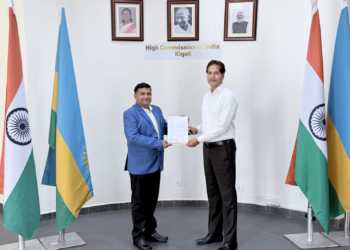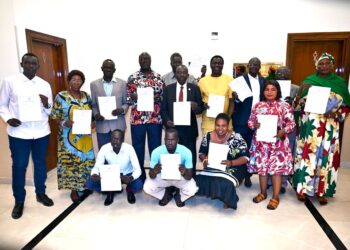



In a groundbreaking move aimed at boosting agricultural productivity and reducing dependency on imported seeds, Rwanda’s Ministry of Agriculture and Animal Resources (MINAGRI), in collaboration with the Rwanda Institute for Conservation Agriculture (RICA) and One Acre Fund (Tubura), has successfully trained and certified 16 new agricultural experts in seed production.
The experts, who completed a year-long program, will now help lead the charge in revolutionizing seed production across the country.
The new graduates, trained in the production of seeds for various crops, are expected to play a pivotal role in increasing yields for Rwandan farmers.
One of the program graduates, Gilbert Turikubwimana, noted that with the newly acquired knowledge, farmers can significantly boost their productivity. “For potatoes, under traditional farming methods, farmers are currently harvesting 10 tons per hectare,” said Turikubwimana. “But with the new techniques we’ve learned, we now know that farmers can achieve up to 25 tons per hectare.”
Another graduate, Irankunda Gisèle Mignone, who specialized in soybean production, explained that with proper cultivation methods, farmers can increase their soybean yields from one and a half tons per hectare to over three tons per hectare.
The certification program was designed and implemented by RICA with support from Tubura, an organization committed to empowering smallholder farmers. The graduates, many of whom were already working at specialized agricultural institutions, will now bring their expertise to the forefront of Rwanda’s growing seed industry.
Eric Pohlman, the Director of One Acre Fund (Tubura), emphasized the importance of local seed production for both food security and economic growth. “Although the Netherlands has a land area similar to Rwanda’s, it exports seeds worldwide. Now, we have the ability to produce seeds locally, and there is a significant gap in the region. Rwanda has the potential to meet the high demand for quality seeds, and there’s no reason why we can’t fill that gap,” Pohlman said.
Dr. Ron Rosati, the Director-General of RICA, also underscored the significance of the training program, which marks a new era for seed production in Rwanda. “Seed production is a new industry in Rwanda,” Dr. Rosati explained. “The challenge was getting it started, but now we’re working quickly to increase the number of specialists in seed production who will work in laboratories and across the country.”
The initiative is part of a broader effort by MINAGRI to reduce Rwanda’s reliance on imported seeds, which have often arrived late or in poor condition, leading to crop failures and financial losses for farmers. Since the program began five years ago, Rwanda has seen a significant improvement in seed availability and quality.
Dr. Patrick Karangwa, Director of Research for Modern Agriculture at MINAGRI, expressed confidence in the future of local seed production. “In the past five years, we’ve tripled the amount of seed we were importing, but that’s not enough,” Karangwa said. “We need seeds of the highest quality, and we want Rwanda to be the go-to place for quality seeds in East Africa. Our long-term goal is to make Rwanda a key player in the international seed market.”
The program has already shown impressive results: RICA’s seed production efforts are currently active on 109 hectares, with substantial quantities of seeds for various crops being produced. According to Dr. Rosati, this marks the beginning of a new phase in Rwanda’s agricultural development. “We’re moving quickly to meet the growing demand for seeds, and we’re building capacity for the future,” he said.
With arable land covering 802,000 hectares in Rwanda, the country has vast potential to produce enough food for its population and even export to international markets. MINAGRI believes that innovations in seed production and advanced agricultural technologies will be key to achieving these goals.
As Rwanda continues to strengthen its agricultural sector, the success of this new seed production initiative could set the stage for a more self-sufficient and prosperous future for Rwandan farmers and the economy as a whole.