

Rwanda has reached a new milestone in its ongoing fight against corruption, achieving its highest-ever score on the 2024 Corruption Perceptions Index (CPI), released on February 11 by Transparency International.
The country moved up six places globally, securing 49th position. Though this represents a slight dip from 43rd place in 2023, Rwanda’s 57% score marks a significant leap from 53% last year, further cementing its role as East Africa’s least corrupt nation.
For the third consecutive year, Rwanda stands at the forefront of anti-corruption efforts in East Africa, outpacing its regional neighbors. Tanzania ranks second in the region, at 82nd globally with a score of 41%, followed by Kenya (121st, 32%), Uganda (140th, 26%), the Democratic Republic of Congo (163rd, 20%), and Burundi (165th, 17%).
On the wider Sub-Saharan African stage, Rwanda holds a strong third place, alongside Botswana, both scoring 57%. Seychelles continues to lead the region with an impressive 72%, slightly up from 71% in 2023, while Cabo Verde follows with 62%, down from 64% last year.
Globally, Denmark retains its position as the least corrupt country with a near-perfect score of 90%, followed by Finland at 88%. The CPI ranks 180 countries and territories, assessing public sector corruption on a scale from 0 (highly corrupt) to 100 (very clean).
Rwanda’s progress is a testament to the government’s enduring commitment to tackling corruption. Marie Immaculée Ingabire, Chairperson of Transparency International Rwanda, attributes this achievement to the country’s unwavering political will. “Rwanda’s improvement in the CPI reflects our government’s commitment to fighting corruption. Our zero-tolerance approach continues to drive meaningful change,” she said.
While celebrating this success, Ingabire also acknowledged that challenges remain. “As highlighted by the Rwanda Bribery Index, there’s still work to be done, especially in certain areas. Continued collaboration across all sectors is key to sustaining and building on this progress.”
Apollinaire Mupiganyi, Executive Director of TI-Rwanda, emphasized the broader consequences of corruption. “Corruption isn’t just a governance issue; it undermines global efforts to tackle crises like climate change, reduces civic space, and encourages illicit financial flows,” he noted. “Fighting corruption is essential for economic stability, justice, and a sustainable future.”
The fight against corruption also takes on new urgency in light of the global climate crisis. Transparency International’s 2024 CPI report draws attention to how corruption exacerbates climate vulnerabilities, particularly in countries like Rwanda. The misallocation of climate funds can delay vital adaptation and mitigation projects, hindering efforts to protect vulnerable communities.
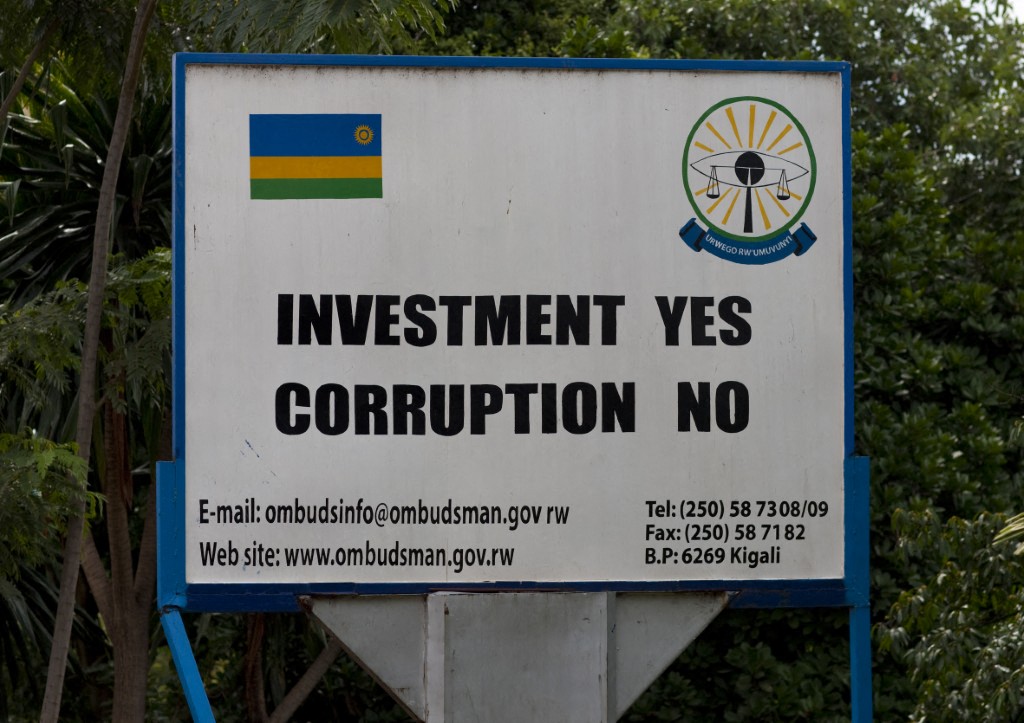
Rwanda’s Chief Ombudsman, Madeleine Nirere, celebrated the nation’s progress but urged continued efforts toward a long-term goal. “This ranking is commendable, but there’s much more to be done. Rwanda aspires to be the least corrupt nation by 2050, and we must intensify our efforts to achieve this vision,” Nirere said.
Despite the challenges, Rwanda’s ascent on the CPI reflects its determination to foster transparency and accountability, with a clear commitment to eradicating corruption by 2050. The path ahead is not easy, but the country’s progress shows that with sustained effort, positive change is within reach.